
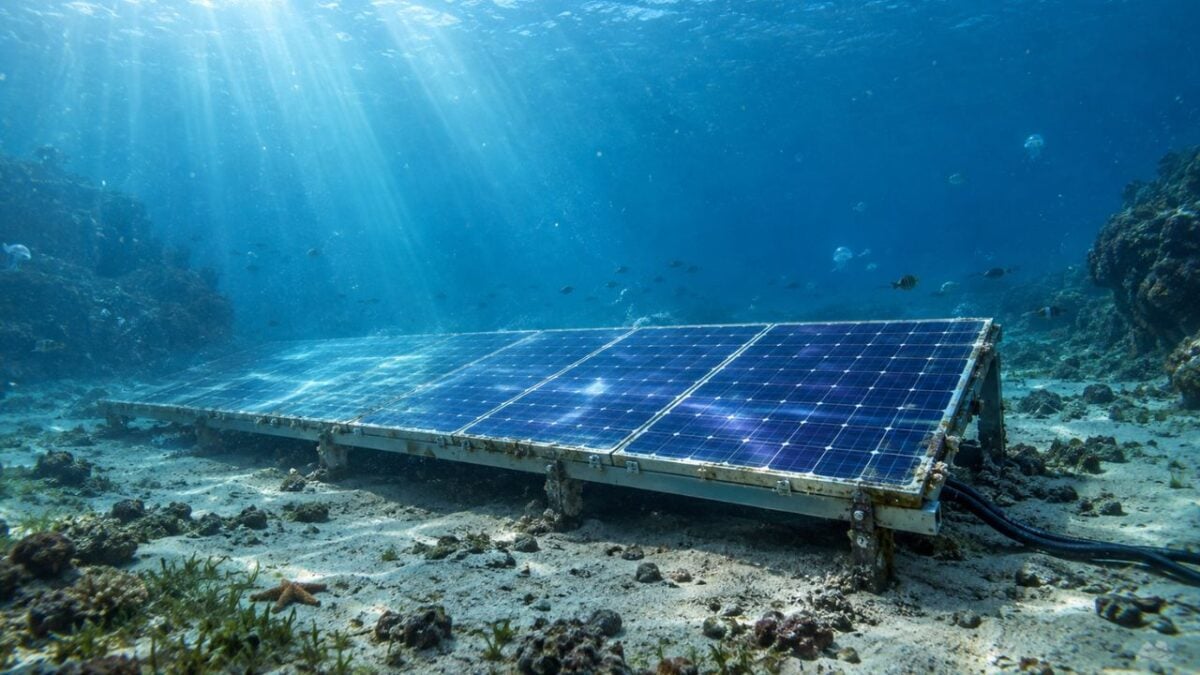
A team of scientists has shown that solar cells can make electricity 10 meters below the ocean surface, a depth that earlier experiments had written off as too dark to be useful.
The trial happened in the South China Sea near the Weizhou Islands, just off the southern coast of mainland China, and the details are now out in the journal Joule.
The cells were built to pick up the types of light that manage to slip through seawater. During a two-hour run, they turned sunshine into power at a depth of 10 meters. Previous work on this idea had never gone past two meters.
Sunshine dies out fast once it enters the ocean. At 10 meters, water has already swallowed or scattered most of the sun’s energy. But not all light behaves the same way, as some travel further than others. The team says there is still enough blue and green light down there to produce a current.
To capture it, they turned to perovskites. This material can be tweaked to respond to specific wavelengths, which sets it apart from the silicon used in everyday solar panels. Inside the lab, under conditions built to mimic 10 meters of seawater, the cells changed roughly 35 per cent of the incoming light into electricity.

- Solar vs Fuel Generators: which is better for power outages and outdoor adventures?
- What are the benefits of using solar panels at home?
Out in the South China Sea, the team scaled things up. At two meters down, 115 square centimeters of panels delivered 1,416 milliwatt-hours across two hours. That works out to about half the charge of a rechargeable AA battery. At 10 meters, the same setup gave 324 milliwatt-hours over two hours. It is not a lot of power, but it beat what the team had expected to see.
Durability was not an issue either. After 1,160 hours in simulated underwater conditions, the panels barely lost any performance. From that result, the team figures the panels could stay active at 10 meters below the sea for roughly five and a half years.
Ocean sensors, cameras and communication devices often work far from any power source. Once their batteries run dry, someone has to go and fetch them. The researchers behind this study think their panels could give that kind of equipment a power supply that keeps going.
Before that happens, they need to know how the panels hold up at greater depths. Their plan is to test exactly that and pin down how far below the surface solar power can realistically work.
Source: Euronews