
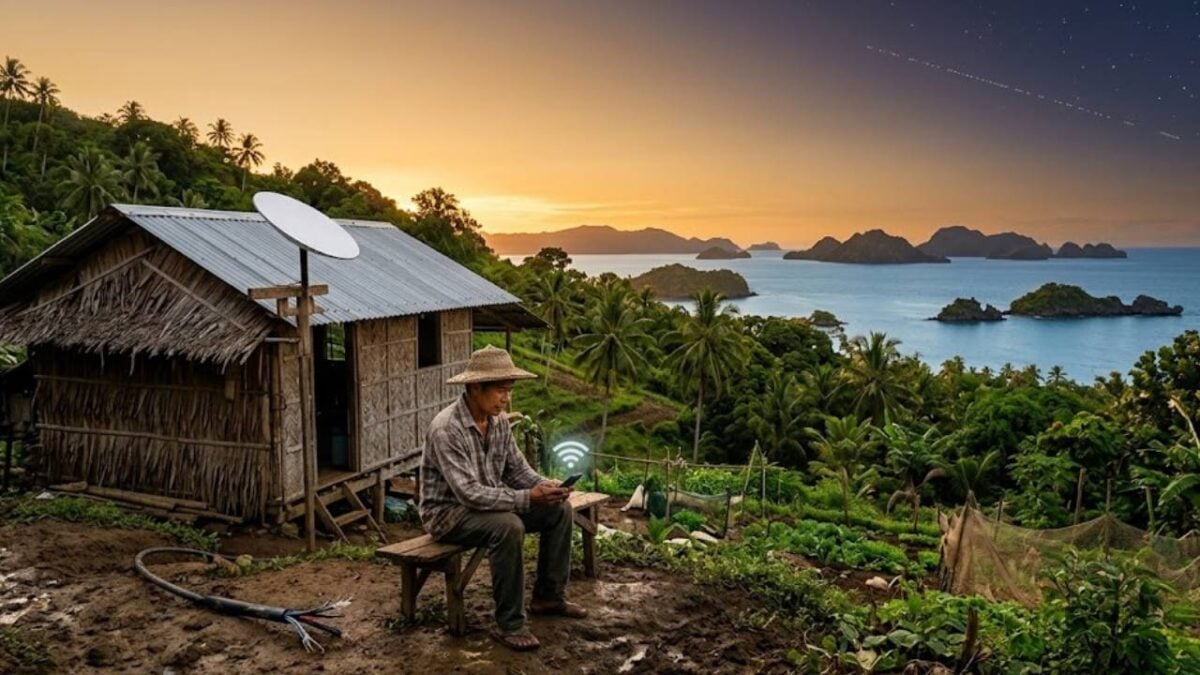
The Philippines has quickly become one of the biggest users of Starlink in the Asia-Pacific region, according to a report from Ookla.
Out of all the countries where Starlink operates, the Philippines now ranks number six globally. In Asia, it comes in second. The report says the country holds roughly 4.2% of all Starlink subscribers worldwide.
But here is the catch. The actual download speed Filipinos get right now is not that high. Ookla’s data shows the typical Starlink user in the Philippines only gets around 55Mbps. That is about half of what the average fixed broadband connection in the country delivers, which is over 100Mbps.

So why do people still choose Starlink? The main reason is geography. The Philippines has over 7,600 islands. Laying down fiber cables or building cell towers everywhere is really difficult and expensive. Starlink works well in remote places where traditional internet cannot reach.
Starlink also beats older satellite services. Older systems use satellites that stay far above the Earth, which causes delays and unstable connections. Starlink uses low Earth orbit satellites that are much closer, which means lower latency and possibly more stable connection.
The report also mentions that Starlink is useful during disasters. When typhoons knock out phone lines and mobile networks, satellite internet can keep working. That makes it a good backup option for remote or disaster-prone areas.
Local telecom companies are taking notice. Globe Telecom has already signed a deal with Starlink to test direct-to-cell services. That could bring mobile coverage to places that currently have no infrastructure at all.
But there are still problems with adoption, cost probably the biggest one. Starlink plans are usually more expensive than fiber, ranging from Php2,700 to Php3,800 per month. And in crowded areas, where many people share the same satellite capacity, speeds can be uneven.
Ookla says Starlink is not likely to replace fiber internet in the Philippines anytime soon. Instead, experts see it as a stopgap solution. It works best for rural homes, small businesses, and government projects that need internet in hard-to-reach spots around the country.
Source: Ookla
Son günlerde mahalledeki eski binaların yıkım sürecini izlerken ister istemez kendi yaşadığım yerin güvenliğini düşünmeye başladım. Süreç hem çok yavaş ilerliyor hem de insanı biraz geriyor, acaba benzer durumlarla karşılaşanlar nasıl bir yol izledi? [vsaabvrujbaxjscqzk]
Simply wanna remark on few general things, The website style and design is perfect, the written content is rattling superb : D.
i0n6u0